


Asset Management and Finance Committee

GOAL: Effective and Financially Sustainable Systems
Communities maintain and improve drinking water, wastewater and stormwater infrastructure systems to
deliver quality water services that meet community needs. Operating budgets and capital investment are
adequate and affordable, resulting in systems that operate efficiently and in a state of good repair.
1.1 Maintaining Systems
Utilities and departments maintain drinking water, wastewater and stormwater pipes and other water
infrastructure assets to efficiently and effectively reduce leakage, emergency repairs and other impacts.
1.2 Wise Management and Spending
State requirements, metrics and incentives along with utility policies ensure that utilities and departments implement water infrastructure asset management programs fully, with sufficient operating budgets and capital investments to deliver required and desired levels of service while minimizing life-cycle costs.
1.3 Adequate and Fair Revenue
Utilities and local governments raise the funds required to make appropriate capital investments and
ensure proper operation and maintenance in a cost-effective, equitable manner that treats ratepayers
fairly. Programs are authorized and established to ensure affordability. Stormwater utilities and
stormwater fees are authorized statewide and widely implemented.
1.4 Robust Government Funding Initiatives
Funding for existing federal water infrastructure financing program is maintained or increased. New state
funding for water infrastructure programs advance Jersey Water Works’ goals.
See Jersey Water Works latest news on paying for water infrastructure and affordability.
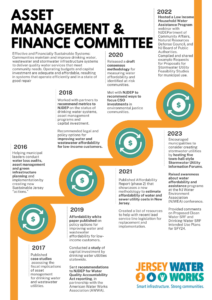
This graphic features committee milestones from 2016-2023.
Graphic created by Shweta Raman. View full image here.
Committee initiatives and work include:




Asset Management & Finance Committee
- Pursue funding and conduct research to assess the feasibility of a wastewater accountability framework (similar to the Water Quality Accountability Act (WQAA)) and develop informed recommendations.
- Leverage newly available water audit data captured under the WQAA to identify and promote best practices. Host a webinar to showcase high-performing utilities and their strategies.
- Explore research on shared services and regionalization, and identify potential funding sources and support opportunities.
- Host a meeting in July with the New Jersey Infrastructure Bank to review the State Fiscal Year (SFY)26 project pipeline, discuss projects deferred to SFY27, assess remaining funds and oversubscription, and identify opportunities to advance projects awaiting funding.
- Review and comment on the SFY27 Clean Water and Drinking Water Intended Use Plans and other public comment opportunities aligned with committee goals.
- Water Affordability: Continue collaborating with state partners to expand water affordability solutions and promote a coordinated statewide approach.
- Stormwater Utilities: Encourage municipalities to consider creating stormwater utilities (facilitated by the Stormwater Utility Subcommittee)
- Revise and distribute the Stormwater Utility presentation for members to use in local presentations.
- Engage with New Jersey Department of Environmental Protection (NJDEP)-funded communities to assess progress following feasibility study funding. Identify barriers and offer targeted support to advance SWU adoption in at least one more community.
- Update the SWU resource center website to feature New Jersey case studies and promote them as best and promising practices for others to learn from.
- Host at least three education events/meetings to enhance understanding of debt, shared services, collaboration, climate resilience, and SRF funding/application processes.
- Promote best practices for innovative low-income discount programs to advance water affordability.
- Review and comment on the FY 2025/FY 2026 Intended Use Plan and other public comment opportunities aligned with committee goals.
- Encourage municipalities to consider creating stormwater utilities (facilitated by the Stormwater Utility Subcommittee)
- Improve communication about stormwater utilities and promote available resources, including the “Stormwater Utilities Can Facilitate Green Infrastructure” paper, the SWU Resource Center, materials for CSO communities, and create a short informational video.
- Organize a webinar highlighting case studies from municipalities on feasibility studies.
- Explore a regional approach for implementing stormwater utilities in New Jersey and assist utilities in defining stormwater management programs to meet community and regulatory needs.
- Review and develop comments on the proposed State Revolving Fund Year 2023 (SRFY 25) Water Infrastructure Investment Plan, which supports the goal of “Effective and Financially Sustainable Systems”. This aims to ensure that operating budgets and capital investment are adequate and affordable, resulting in systems that operate efficiently and in a state of good repair (completed).
- Educate legislative staff and decision makers about congressionally directed funding (CDF), formerly known as earmarks, by sharing information via letter, newsletters, and social media.
- Launch a research/study on the long-term benefits of investing in water infrastructure.
- Host a webinar highlighting strategies to create equitable rate structures that address low-income affordability issues while providing financial benefits to the utility, recruit at least one utility, and include community voices.
- Encourage municipalities to consider creating stormwater utilities (facilitated by the Stormwater Utility Subcommittee)
- Improve communications around Stormwater Utilities (SWUs).
- Issue a 2-4 minute Informational Video.
- Update the 2021 paper entitled “Stormwater Utilities Can Incentivize Green Infrastructure”.
- Explore existing or create new SWU resources for combined sewer overflow (CSO) communities.
- Promote the SWU Resource Center.
- Support the exploration of a regional approach to operationalizing Stormwater Utilities in New Jersey.
- Improve communications around Stormwater Utilities (SWUs).
- Advance water and wastewater affordability for low-income customers by:
- Raising awareness of the Low Income Household Water Assistance (LIHWAP) Program to increase participation.
- Promoting and sharing the findings of the study, A New Jersey Affordability Methodology and Assessment for Drinking Water and Sewer Utility Costs.
- Creating a resource guide for NJ water/wastewater systems to develop local affordability solutions, including in support of new Environmental Protection Agency (EPA) guidelines under the Clean Water Act.
- Working with New Jersey Department of Environmental Protection (NJDEP) to develop technical assistance and planning grants to seed innovative utility level affordability ideas in NJ.
- Provide feedback on the NJDEP implementation of the Water Quality Accountability Act (WQAA) rules (to be issued in 2023).
- Expand information about all available funding dollars by developing an easy to understand factsheet.
- Submit comments on the proposed SRFY 24 Water Infrastructure Investment Plan. (This item has already been completed.)
- Encourage municipalities to consider creating stormwater utilities by:
- Finalizing an educational video explaining the need for and benefits of a stormwater utility.
- Providing technical assistance office hours through the stormwater utilities subcommittee meeting.
- Advance water and wastewater affordability for low-income customers by:
- Advance water/wastewater affordability for low-income customers by:
- Developing recommendations on the Low Income Household Water Assistance Program to the Department of Community Affairs based on insights from utilities.
- Promote and share the findings of the study, A New Jersey Affordability Methodology and Assessment for Drinking Water and Sewer Utility Costs, with stakeholders.
- Support the New Jersey Department of Protection (NJDEP) implementation of the Water Quality Accountability Act (WQAA) by providing feedback on reporting requirements, expanding outreach/sharing information, and exploring data connection to Jersey WaterCheck.
- Submit comments on the proposed Water Infrastructure Investment Plan.
- Create two products on stormwater utilities for use by localities:
- An educational video explaining the need for/benefits of a stormwater utility
- A model scope of work for a stormwater utility feasibility study.
- Advance water/wastewater affordability for low-income customers by:
- Advance water/wastewater affordability for low-income customers by:
- (a) Developing recommendations for an emergency assistance program in New Jersey, and work towards implementing a permanent program.
- (b) Coordinating with the BPU water workgroup on its structure and outreach.
- (c) Communicating, sharing, and using the consensus methodology report measuring affordability.
- Develop guidance for drinking water utilities to complete lead service line inventories.
- Develop and implement actions for the committee to increase the committee’s racial, gender, and sector diversity.
- Coordinate with the CSO Committee on LTCP implementation and stormwater fee options for CSO communities.
- Advance water/wastewater affordability for low-income customers by:
- Advance water and sewer affordability for low-income customers by:
- (a) Producing recommendations to implement the white paper state policy options report released in 2019.
- (b) Establishing a consensus methodology for measuring affordability issues, applying it to assess NJ communities, and publishing the findings.
- (c) Work with the Combined Sewer Overflow committee to identify ways to address affordability in Long Term Control Plans and recommend them to the New Jersey Department of Environmental Protection (DEP).
- Review and issue comments on state government proposals relating to water financing and asset management plans, including the Water Quality Accountability Act.
- Work to increase the number of committee members and their racial and gender diversity.
- Advance water and sewer affordability for low-income customers by:
- Advance water and sewer affordability for low-income customers by:
- (a) Finalizing and issuing a white paper with a menu of state policy options to ensure affordability.
- (b) Establishing a consensus methodology for measuring affordability issues, using it to assess New Jersey communities, and issuing a report on the benchmark findings.
- Issue a baseline assessment of drinking water utility capital investments in New Jersey.
- Review and issue comments on state government proposals, including New Jersey Department of Environmental Protection guidance for stormwater utilities, efforts to require asset management for wastewater systems, and Water Quality Accountability Act recommendations.
- Recommend, in partnership with industry groups, level-of-service goals for use with asset management programs.
- Represent Jersey Water Works and promote its work at industry and partner conferences and workshops, in coordination with backbone staff.
- Advance water and sewer affordability for low-income customers by:
- Examine the legal impediments to establishing water infrastructure ratepayer assistance programs in New Jersey and identify policy recommendations to overcome them.
- Publish a report on “Cost Effective Investments for Water Infrastructure” and host an event to discuss implementation.
- Host educational events that utilize the framework provided by the NJ AIMS Guide, including training on water loss audits.
- Propose a completed Asset Management “action” for the Sustainable Jersey certification program.
- Publish case studies on the financial benefits of asset management for drinking water and wastewater utilities.
- Assess the New Jersey Environmental Infrastructure Trust green infrastructure financing program to identify ways to improve applicant success at obtaining funding.
- Publish a national survey of state-level initiatives to fund water infrastructure.
- Facilitate the development of a case study of the fiscal implications of asset management at Camden County Municipal Utilities Authority.
- Develop an on-line water infrastructure finance clearinghouse with references, resources and links to the following: grant/funding resources, innovative financing methods. alternative project delivery structures, New Jersey enabling statutes.
- Assess NJEIT financed integrated green and green infrastructure stormwater management projects that feature successful designs and financing applications and highlight intervention points and advocacy efforts that can improve the financing process and ultimately increase the number of projects funded.
- Benchmark wastewater and water-supply utility emergency repair costs.
- Review and catalog existing state water-related household assistance programs.
- Co-hosted three educational webinars on debt, shared services, collaboration, climate resilience, and State Revolving Funds (SRF) funding, reaching over 120 participants with New Jersey Future’s Funding Navigator program, the Syracuse University Environmental Finance Center, and other partners.
- Reviewed and submitted comments on the FFY 2025/SFY 2026 Intended Use Plans.
Stormwater Utilities (SWU) Subcommittee
- Promoted stormwater utilities and resources to municipalities. This year, New Jersey established its fourth stormwater utility.
- Hosted a meeting to learn about two state-funded stormwater utility projects with WSP.
- With ANJEC, organized a webinar featuring the Maplewood mayor and Stormwater Utility Manager to showcase the town’s Stormwater Utility implementation, with 63 attendees.
- Created a scorecard to review SWU progress.
Water Affordability Subcommittee
- Secured funding from the Geraldine R. Dodge Foundation to work on water affordability.
- Helped advance water affordability goals by convening partners from Trenton, Newark, Paterson, Atlantic City, and Camden, and working closely with NRDC and New Jersey Future.
- Submitted comments on Clean Water and Drinking Water State Revolving Fund Year SRFY 25 Intended Use Plans, Water Quality Accountability Act Proposed rules amendments, and repeals to the Safe Drinking Water Act Rules (N.J.A.C. 7:10) and Water Supply Allocation Permit Rules (N.J.A.C. 7:19).
- Sent letters to legislative staff educating about congressionally directed funding (CDF).
- Developed and published a funding tracking list for water infrastructure projects.
- Stormwater Utility Subcommittee:
- Encouraged municipalities to consider stormwater utilities and regional approaches.
- Met regularly to share updates on feasibility studies and explore different tactics.
- Updated the 2021 paper “Stormwater Utilities Can Incentivize Green Infrastructure.”
- Organized a JWW conference session, Unlocking the Potential of Stormwater Utilities: Perspectives and Progress in New Jersey.
- Expanded information about available funding via a technical assistance (TA) webinar, blog, social media, and newsletters.
- Encouraged municipalities to consider creating stormwater utilities by hosting five town-hall style Stormwater Utility Information Forums, attended by over 70 participants.
- Raised awareness about water affordability and assistance programs via presentation at the NJ Water Environment Association (NJWEA) conference and by creating social media content, publishing a blog, and sharing information via newsletter on the Low Income Household Water Assistance Program (LIHWAP).
- Submitted comments on Proposed Clean Water SRF and Drinking Water SRF Intended Use Plans for SFY23.
- Published blog, Affordability of Residential Drinking Water and Sewer Utility Services blog.
- Hosted a Low Income Household Water Assistance Program webinar in partnership with NJ Department of Community Affairs, Natural Resources Defense Council, and NJ Board of Public Authorities with a follow up discussion scheduled for December 8, 2022.
- Compiled and shared example Requests for Proposals for Stormwater Utility Feasibility Studies for municipal use.
- Developed and shared sample Stormwater Utility outreach digital toolkit for municipal use.
- Sent a letter to the Governor’s Office, Department of Community Affairs, Board of Public Utilities, and Department of Environmental Protection identifying opportunities for the State of New Jersey that can help to ensure affordable water services. Read Letter
- Published Affordability Report (phase 2) that showcases a new methodology to estimate affordability of water and sewer utility costs in New Jersey.
- Created a list of resources to help with recent lead service line legislation for replacement and implementation (to be published in late December 2021).
- Expanded committee diversity through outreach to work toward closing gaps and expanding committee racial, gender, and sector makeup.
- Submitted recommendations in response to the COVID-19 outbreak to the Governor’s office, which address the impacts on low-income customers and water and wastewater utilities.
- Released a draft consensus methodology for measuring water affordability and identified at-risk communities.
- Met with NJDEP to recommend ways to focus CSO investments in environmental justice communities as a joint exploration with the CSO Committee.
- Identified gaps in committee membership to inform the adoption of diversity goals.
- Published a white paper on policy options for improving water and wastewater affordability for low-income customers.
- Conducted a study of capital investment by drinking water utilities statewide.
- Sent recommendations to the New Jersey Department of Environmental Protection for Water Quality Accountability Act reporting, in partnership with the American Water Works Association.
- Worked with industry partners to recommend metrics to NJDEP on the status of drinking water systems, asset management programs and capital investment.
- Recommended legal and policy options for improving water and wastewater affordability for low-income customers.
- Hosted a peer review of New Jersey Water Bank’s green infrastructure financing program, identifying ways to improve applicant success.
- Published in-depth case studies assessing the fiscal implications of asset management for drinking water and wastewater utilities.
- Published a national survey of state-level initiatives to fund water infrastructure.
- Launched research on two case studies, in partnership with the New Jersey Environmental Infrastructure Trust, into the fiscal implications of wastewater utility asset management programs.
- Initiated the evaluation of the state’s financing programs for green infrastructure.
-
 01/31/24
Jersey Water Works Comments on the SFY25 Proposed Intended Use Plans
On January 31, 2024, the Jersey Water Works Asset Management and Finance Committee submitted comment on the SFY25 Proposed Intended Use Plans.LEARN MORE#Paying for Water InfrastructurePRODUCT OF
-
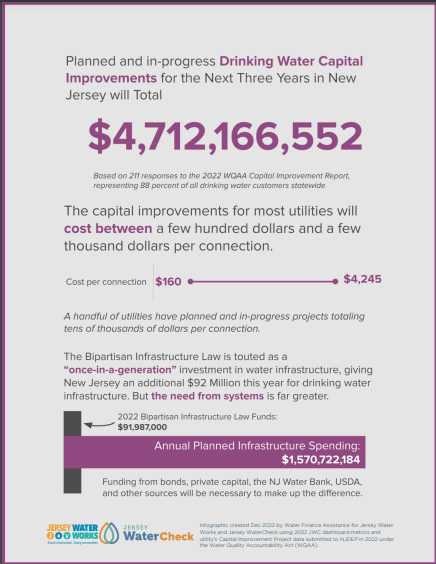 02/01/23
New Jersey Capital Investment Infographic
This infographic accompanies the guest blog, New Jersey’s Capital Investment: A JerseyWaterCheck Data Story.LEARN MORE#Affordability,#DataPRODUCT OF
-
 04/26/22
Jersey Water Works Comments on the Proposed Clean Water SRF and Drinking Water SRF Intended Use Plans for SFY23
The Jersey Water Works Asset Management and Finance Committee submitted comments to the New Jersey Department of Environmental Protection on the proposed Intended Use Plans (IUPs). The IUPs establish the policies and priorities of the New Jersey Water Bank, which administers New Jersey's State Revolving Fund.LEARN MORE#Paying for Water InfrastructurePRODUCT OF
-
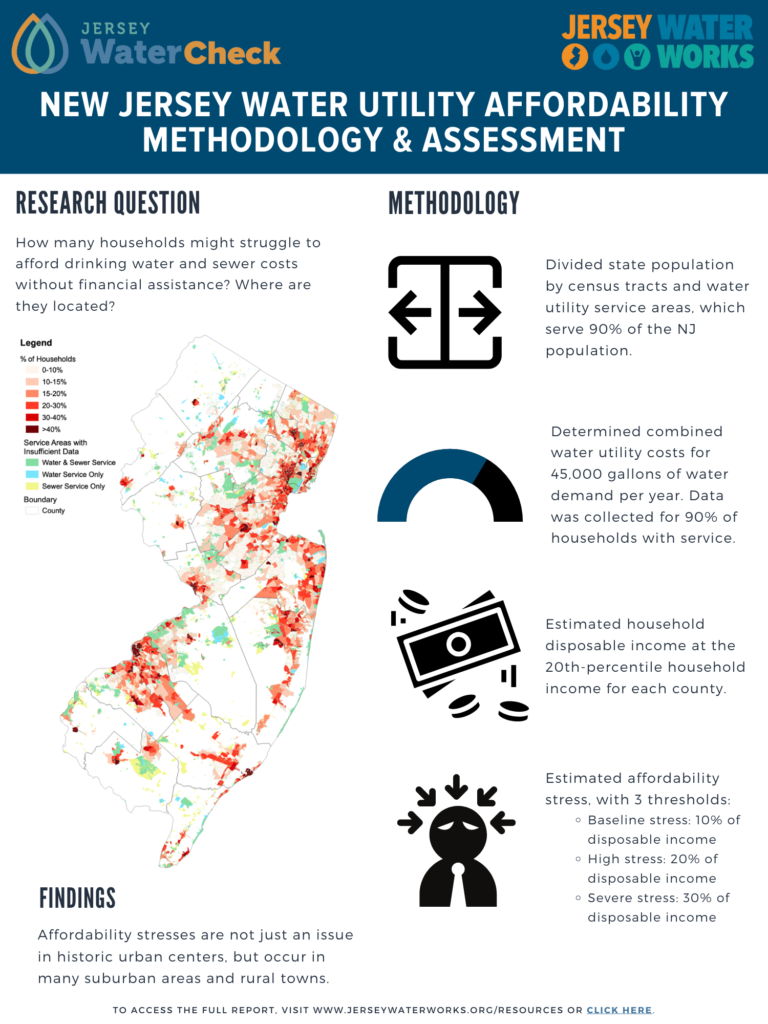 12/07/21
New Jersey Water Utility Affordability Methodology & Assessment Infographic
This infographic accompanies a new Jersey Water Works report, A New Jersey Affordability Methodology and Assessment for Drinking Water and Sewer Utility Costs.LEARN MORE#AffordabilityPRODUCT OF
-
 09/07/21
A New Jersey Affordability Methodology and Assessment for Drinking Water and Sewer Utility Costs
This report, A New Jersey Affordability Methodology and Assessment for Drinking Water and Sewer Utility Costs, presents a detailed methodology for assessing the extent to which current drinking water and sewer utility costs pose a major financial burden for New Jersey households. The report also provides the results from applying the methodology using utility rate schedules from the year 2020, and the most recent information on household incomes ...LEARN MORE#AffordabilityPRODUCT OF
Co-Chairs
*Member of the Jersey Water Works Steering Committee