


Combined Sewer Overflow Committee

GOAL: Smart Combined Sewer Overflow (CSO) Plans
Municipalities and utilities adopt innovative CSO Long Term Control Plans (LTCPs) with cost-effective
solutions that meet or exceed permit requirements and provide multiple community benefits.
4.1 Balancing Pipes and Parks
LTCPs incorporate and commit to an optimized balance of green and gray infrastructure to achieve the
goals of the Clean Water Act.
4.2 Reducing Combined Sewer Flows
LTCPs prioritize proven approaches that reduce combined sewer system flows, such as inflow and infiltration (I & I) reduction, green stormwater infrastructure and water conservation.
4.3 Serving Host Communities
Implementation of the LTCPs reflects early input of community stakeholders and delivers significant additional community benefits including improved public health, green space, economic revitalization and local jobs.
4.4 Affordable Combined Sewer Overflow (CSO) Solutions
CSO LTCPs help ensure affordability for all ratepayers by using cost-effective overflow-reduction
strategies, state and federal funding assistance, equitable rate structures, innovative financing mechanisms, appropriate implementation schedules and leveraging of other public and private investments.
See Jersey Water Works latest news on smart CSO control plans and workforce.
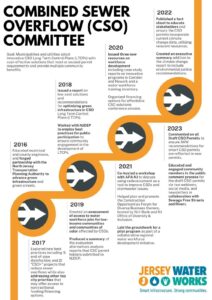
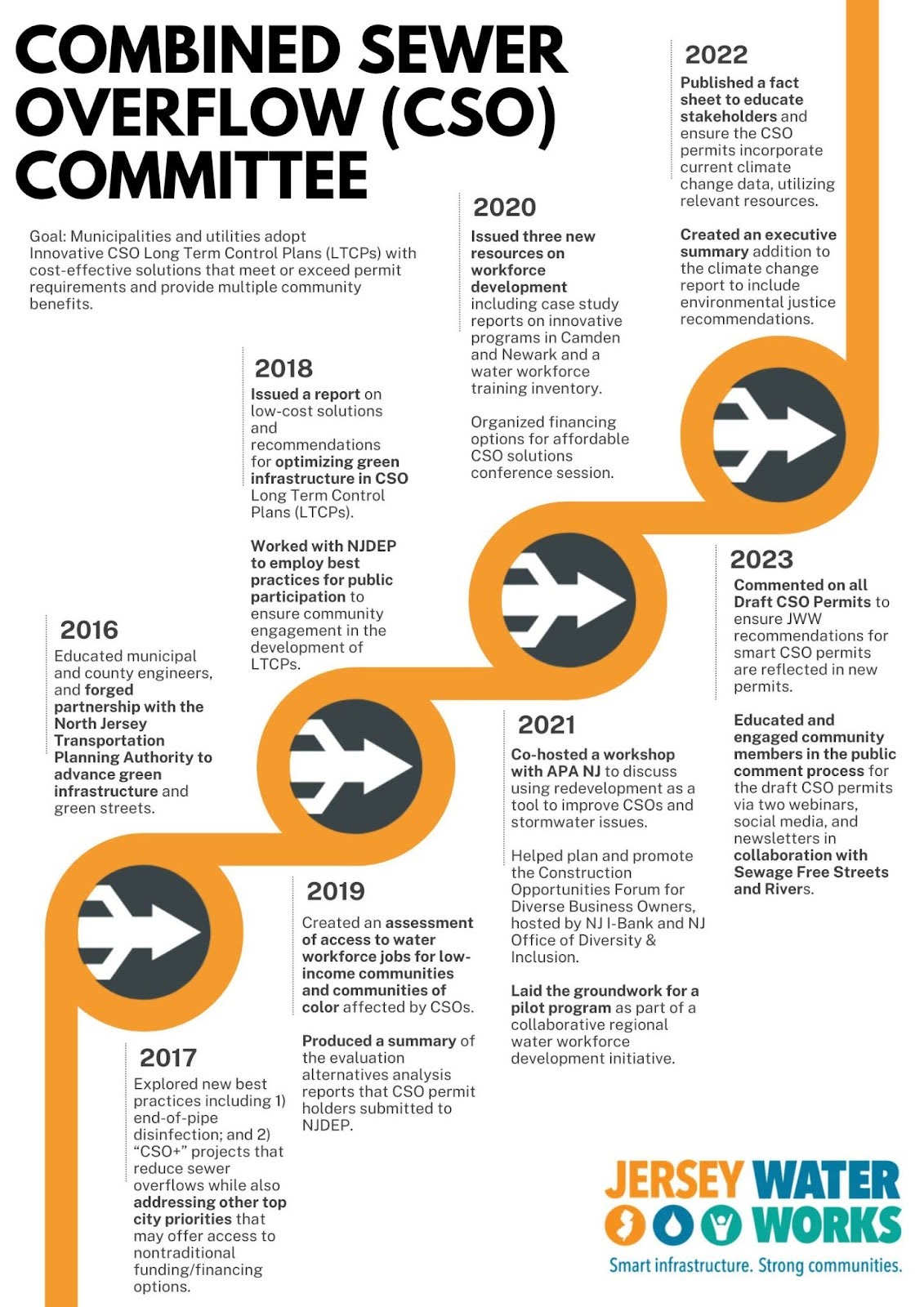
This graphic features committee milestones from 2016-2023.
Graphic created by Shweta Raman. View full image here.
Committee initiatives and work include:






- Assess the potential of creative financing options, such as a bond initiative or stormwater fee, and develop recommendations and resources to encourage municipalities and utilities to address generational equity.
- Work with the Asset Management and Finance committee to articulate the long-term economic and societal benefits of major cost-effective projects, where cost-effectiveness is measured by costs relative to reduced CSOs and Combined Sewer System (CSS) backflows.
- Support CSO municipalities and utilities in increasing visibility through education and social media campaigns. Emphasize the importance of upstream and downstream communities within the sewer system working together to address CSO flow issues.
- Work with NJDEP to ensure that the Jersey Water Works (JWW) “Smart CSO Control Plan” goals are reflected in the last two draft CSO permits, which include reviewing and developing comments for each regional permit.
- Identify and engage with at least two wastewater utilities related to their work on CSOs to gain insight, and elevate utility-level best practices.
- Collaborate and support Sewage-Free Streets and Rivers’ efforts around continued advocacy for the accelerated release of the final Long-Term Control Plans/five-year permits and monitor permit implementation progress.
- Encourage NJDEP to require a CSO affordability analysis with and without typical SRF funding and stormwater fees with the goal of reducing timelines and increasing environmental and public health benefits.
- Work with NJDEP to ensure that the Jersey Water Works (JWW) “Smart CSO Control Plan” goals are reflected in the last two draft CSO permits, which include reviewing and developing comments for each regional permit.
- Share information with CSO decision makers about all available funding to lower total ratepayer costs and accelerate implementations.
- Promote community engagement opportunities within CSO communities (i.e. CSO supplemental teams), uplifting NJDEP community engagement guidance, and continuous education about the CSO process. Work closely with Sewage-Free Streets and Rivers in their efforts.
- Research and share promising practices in CSO management, including regional authority approaches (partnership role, shared services, affordability analysis with new funding).
- Encourage NJDEP to require a CSO affordability analysis with and without typical SRF funding and stormwater fees with the goal of reducing timelines and increasing environmental and public health benefits.
- Work with NJDEP to ensure that the Jersey Water Works (JWW) “Smart CSO Control Plan” goals are reflected in the next CSO permits, which include reviewing and developing comments for each regional permit.
- Continue collaboration with Sewage Free Streets and Rivers on promoting the public comment process, and educating and engaging community members.
- Aid implementation of CSO permits by identifying and sharing funding opportunities for CSO permittees and communities.
- Work with the NJDEP to ensure that the JWW “Smart CSO Control Plan” goals are reflected in the next CSO permits, which will include reviewing the permits and developing comments.
- Educate stakeholders to ensure the CSO permits incorporate current climate change data, utilizing the Committee’s recent climate change resource and other relevant resources.
- Create a guidance document with case studies to promote ways that local planners and officials can reduce sewage generation and capture stormwater to mitigate CSOs.
- Work with the NJDEP to ensure that the next CSO permits reflect this committee’s Jan. 2021 recommendations for Long Term Control Plans that ensure equity and achieve maximum environmental and community benefits.
- Meet with planning staff in three or more municipalities to recommend master plan and zoning changes that integrate CSO solutions including green infrastructure.
- Create a campaign to educate CSO local governments and stakeholders on the benefits of implementing stormwater utilities with the goal of at least one community implementing a stormwater utility in 2021.
- Use a survey to identify LTCP-related job opportunities and workforce training programs and share them with residents of CSO communities.
- Facilitate stakeholder meetings to establish a plan for a collaborative regional water workforce development initiative.
- Host a webinar or workshop to share CSO system success stories.
- Work with the Asset Management and Finance committee to identify ways to address affordability in Long Term Control Plans and recommend them to the DEP.
- Develop a framework for reviewing draft Long Term Control Plans (due to the DEP on June 1) send committee comments to the DEP and assist CSO communities in reviewing the plans.
- Develop recommendations and resources that will encourage local hire from environmental justice communities for water workforce jobs, link local residents to stable careers through job training programs and link utilities and unions to these training programs and to find qualified workers.
- Encourage CSO municipalities to seek funding from the NJ Infrastructure Bank in order to reduce the cost of implementation of the Long-Term Control Plans.
- Maximize the impact of the CSO Committee’s reports Balancing Green and Gray Solutions to CSO Management and Hidden Capacity: How Proper Maintenance and Cleaning of Sewer Systems Can Have Huge Benefits! through promotion and active distribution of the documents to stakeholders including New Jersey Department of Environmental Protection (DEP), CSO supplemental teams, and others.
- Assist CSO municipalities and utilities with resource gaps by providing technical assistance, resource sharing, or other means.
- Review the Development and Evaluation of Alternatives reports due to DEP on July 1 and develop a summary document highlighting:
- (a) Consideration of green and gray infrastructure
- (b) Consideration of community input
- (c) A list of the alternatives considered in each report with descriptive information on their review
- (d) Innovative ideas
- Share with CSO permit holders next-tier opportunities related to CSO mitigation such as integrated planning, increased community engagement, workforce development with green infrastructure, odor control best practices, and the CSO/climate connection.
- Produce public participation materials for the new municipal separate storm sewer (MS4) permit.
- Develop a strategic communications plan that identifies event-oriented social media campaigns and tools for committee members to use to engage stakeholders in water infrastructure issues.
- Provide tools and resources needed by CSO permit holders to address public participation requirements.
- Compile and share a collection of educational curricula about water infrastructure.
Under Former Community Engagement Committee
- Produce public participation materials for the new municipal separate storm sewer (MS4) permit.
- Develop a strategic communications plan that identifies event-oriented social media campaigns and tools for committee members to use to engage stakeholders in water infrastructure issues.
- Provide tools and resources needed by CSO permit holders to address public participation requirements.
- Compile and share a collection of educational curricula about water infrastructure.
- Submitted comments to the New Jersey Department of Environmental Protection on the New Jersey Pollutant Discharge Elimination System (NJPDES) Draft Combined Sewer Overflow Permits for Passaic Valley Sewerage Commission (PVSC), City of Bayonne, Borough of East Newark, Town of Harrison, Jersey City Municipal Utilities Authority, Town of Kearny, City of Newark, North Bergen Municipal Utilities Authority, and City of Paterson.
- Co-hosted a public engagement workshop on providing input for NJDEP’s strategies to reduce flooding and sewage overflows in the PVSC service region. Collaborated with Sewage Free Streets and River, Hackensack River Keeper, Keep America Beautiful Newark, Newark DIG, NJ/NY Baykeeper, South Ward Environmental Alliance, Sustain Work, Wade Trim, and New Jersey Future for the workshop.
- Convened a meeting with Passaic Valley Sewerage Commission to learn about their work and explore future collaboration (21 attendees).
- Submitted comments to the New Jersey Department of Environmental Protection on the New Jersey Pollutant Discharge Elimination System (NJPDES) Draft Combined Sewer Overflow Permits Camden County Municipal Utilities Authority (NJ0026182), Gloucester City (NJ0108847), and the City of Camden (NJ0108812).
- Hosted the Funding Opportunities through FEMA BRIC meeting with NJ Office of Emergency Management (40 attendees).
- Promoted community engagement opportunities within CSO communities.
- Collaborated with Sewage-Free Streets and Rivers leadership program.
- Published a blog highlighting Camden County Municipal Utilities Authority updates.
- Coordinated a conference session, Towards a One Water Future: Effective Combined Sewer Overflow Solutions with Active Community Involvement, to highlight the efforts of the North Hudson Sewerage Authority and Camden County Municipal Utilities Authority.
- Reviewed and submitted comments on the draft Combined Sewer Overflow Permits for Guttenberg/North Bergen Municipal Utility Authority, North Hudson Sewerage Authority, City of Elizabeth and Joint Meeting of Essex & Union Counties, Bergen County Utilities Authority, Borough of Fort Lee, City of Hackensack, and Village of Ridgefield Park to ensure JWW recommendations for smart CSO permits are reflected in new permits.
- Submitted comments on NJDEP’s Guide to CSO Public Engagement, which permittees can utilize to enhance their public engagement efforts to
suit the needs of their specific community. - Educated and engaged community members in the public comment process for the draft CSO permits via two webinars, social media, and newsletters in collaboration with Sewage Free Streets and Rivers.
- Committee met and discussed recommendations while waiting for the release of the CSO permits. Committee wants to ensure that the JWW “Smart CSO Control Plan” goals are reflected in the next CSO permits.
- Published a fact sheet to educate stakeholders and ensure the CSO permits incorporate current climate change data, utilizing relevant resources.
- Created a supplement executive summary to the climate change report to include environmental justice recommendations.
- Created an Ask Card as a tool to encourage planners, municipal officials, and community members to review long-term control plans (LTCP) plans for resilience and adaptability to climate change.
- Provided recommendations for the next CSO permits after reviewing the NJDEP’s technical response letters on the Long Term Control Plans.
- Co-hosted a workshop with APA NJ to discuss using redevelopment as a tool to improve CSOs and stormwater issues in general.
- Helped plan and promote the Construction Opportunities Forum for Diverse Business Owners, hosted by NJ I-Bank and NJ Office of Diversity & Inclusion.
- Laid the groundwork for a pilot program as part of a collaborative regional water workforce development initiative.
- Published a summary of Development and Evaluation of Alternatives Reports that CSO permit holders submitted to the New Jersey Department of Environmental Protection.
- Issued a case study on two workforce training programs in Camden, providing an overview that communities can refer to if they wish to create their own program. The programs were created to train residents of low-income communities and communities of color in green infrastructure maintenance and/or connect them to employment opportunities, including those in the water industry.
- Published a report on two Newark training programs to help bolster its water workforce.
- Produced a summary of Development and Evaluation of Alternatives Reports that CSO permit holders submitted to the New Jersey Department of Environmental Protection.
- Created an assessment of access to water workforce jobs for low-income communities and communities of color affected by CSOs.
- Gave multiple presentations at industry events on technical research conducted by the committee.
- Hosted peer-to-peer learning sessions to support the development of LTCPs with robust public participation and well-informed consideration of alternatives.
- Created a dedicated clearinghouse for LTCP resources to foster and promote collaboration an information-sharing among permittees.
-
 03/22/19
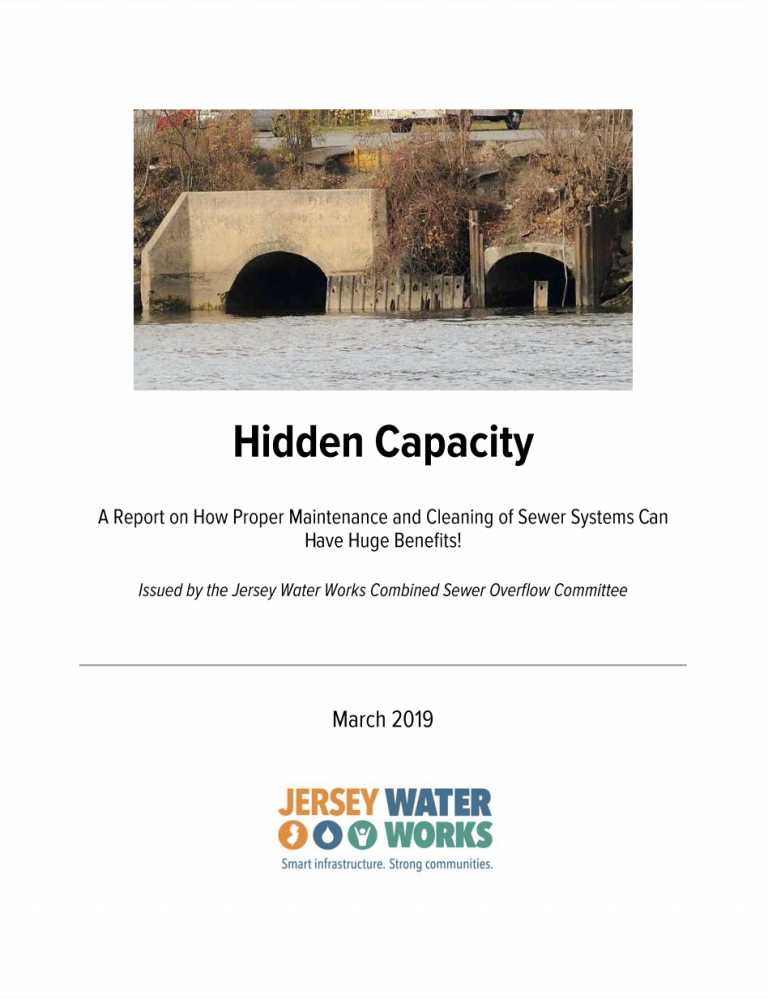
Hidden Capacity: How Proper Maintenance and Cleaning of Sewer Systems Can Have Huge Benefits!
Issued by the JWW Combined Sewer Overflow Committee, the purpose of this paper, Hidden Capacity: How Proper Maintenance and Cleaning of Sewer Systems Can Have Huge Benefits!, is to highlight the importance of sewer cleaning and inspection as critical elements of a proper and effective sewer system operation and maintenance program. Additional basic, cost-effective “gray” type controls, which have the potential to reduce combined sewer overflows ...LEARN MORE#Smart CSO Control PlansPRODUCT OF
-
 12/06/18
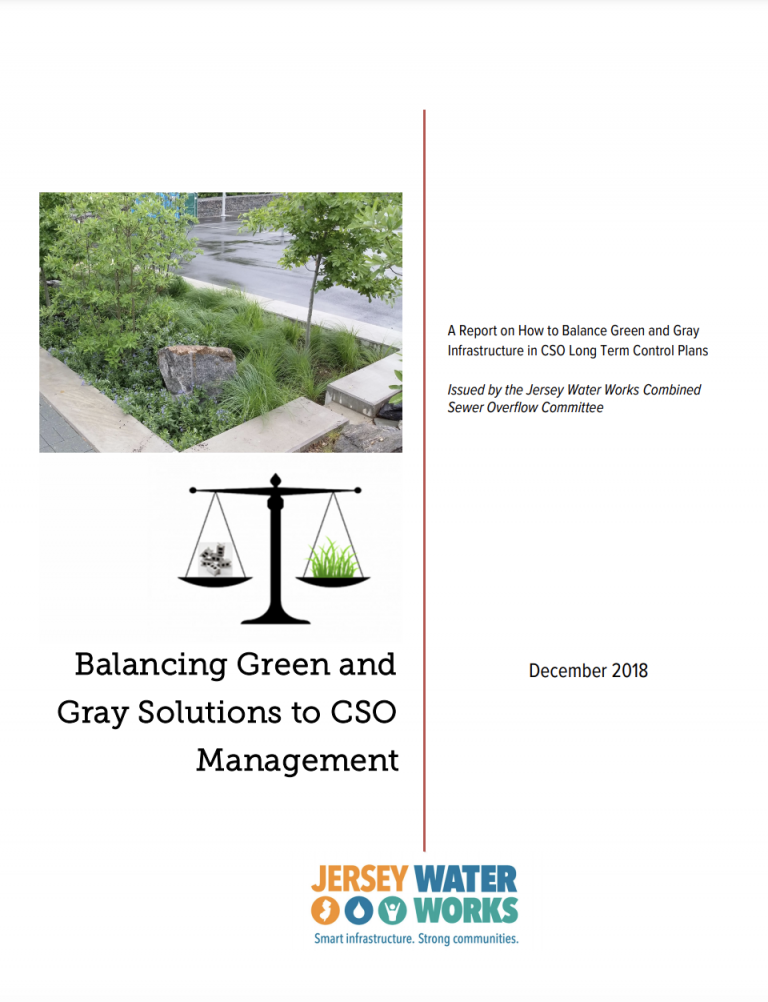
Balancing Green and Gray Solutions to CSO Management
The purpose of this report, Balancing Green and Gray Solutions to CSO Management, is to provide guidance to CSO permit holders and their Supplemental CSO Community Teams, to help guide the development of LTCPs for determining an optimal green/gray balance. Although the target audience is permittees and their communities, other readers should benefit from the summary of current CSO programs. It is recognized that there are varying paths towards ...LEARN MORE#Green Infrastructure/Stormwater Management,#Smart CSO Control PlansPRODUCT OF
-
 11/28/17
Impact of Proper Maintenance of Combined Sewer Overflow System on Flooding in the City of Camden
This fact sheet was prepared in 2017 by Jersey Water Works' Best Practices Committee (committee later renamed). It summarizes a case study performed by CDM Smith, an engineering firm, and commissioned by the Camden County Municipal Utilities Authority. The was predicted by modeling Camden’s combined sewer system (CSS) and measuring the changes in the volume of stormwater conveyed to water pollution control facilities (WPCFs), combined-sewer ...LEARN MORE#Smart CSO Control PlansPRODUCT OF
Co-Chairs
*Member of the Jersey Water Works Steering Committee