


Green Infrastructure Committee

GOAL: Successful and Beneficial Green Infrastructure
Communities employ green infrastructure in a way that maximizes community benefits including reduced flooding and improved water quality, local economies, community health and long-term resiliency.
3.1 Installing Green Infrastructure
The public and private sectors integrate green stormwater infrastructure into new projects, redevelopment projects, and existing facilities.
3.2 Reducing Flooding
Utilities and government departments employ green infrastructure to reduce flooding caused by
inadequate wastewater and stormwater systems.
See Jersey Water Works latest news on green infrastructure / stormwater management.
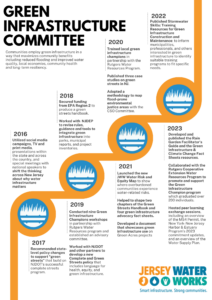
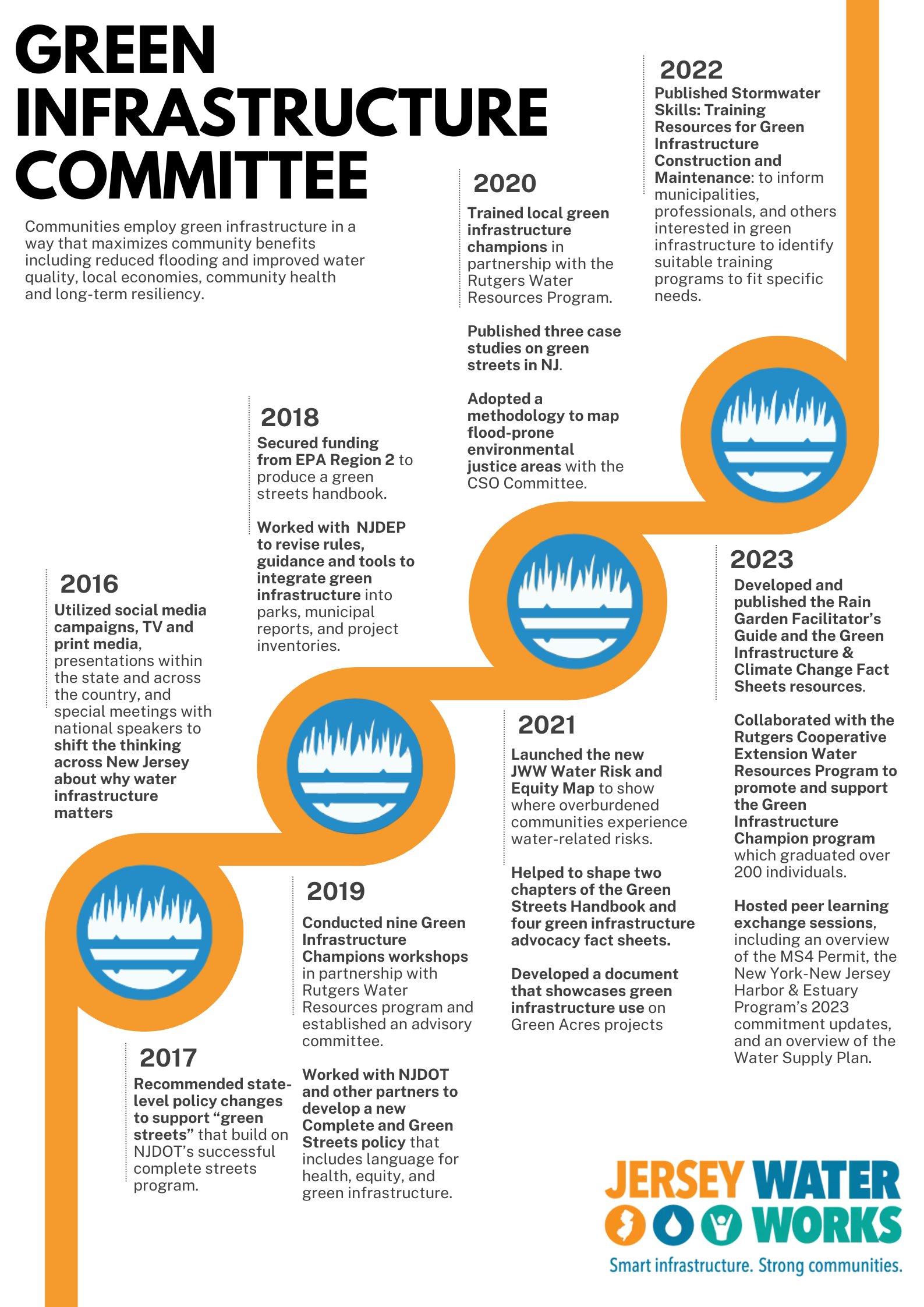
This graphic features committee milestones from 2016-2023.
Graphic created by Shweta Raman. View full image here.
Committee initiatives and work include:






- Foster collaborative discussions to address 2026 Green Infrastructure challenges and opportunities.
- Identify and share funding opportunities for green infrastructure projects.
- Promote green infrastructure implementation best and promising strategies, as towns advance MS4 permits and related projects.
Note: The Watershed Institute is providing backbone support for the GI committee.
- Advance implementation of green infrastructure by highlighting local educational or volunteer opportunities and organize at least one in-person meeting/GI tour.
- Elevate two green infrastructure success story examples to showcase effective GI practices to inspire and educate others.
- Provide Municipal Separate Storm Sewer System (MS4) and retrofit guidance for municipalities.
- Connect communities to funding: Guide communities toward funding available for green infrastructure projects, and work with state and federal agencies to gather information on funding opportunities.
- Increase access to GI resources: Explore how to offer green infrastructure resources in different languages. Work with JWW member organizations and identify advocacy groups to help elevate resources beyond JWW.
- Connect with communities through projects: Identify hands-on activities or in-person events to be present during and share resources. Host at least one in-person committee meeting with an educational component.
- Create a green infrastructure outreach guidance inventory for GI Champions that outlines materials, resources, presentations, and key takeaways based on the audience.
- Collaborate with the Climate Resilience Committee on the New Jersey Protecting Against Climate Threats (NJ PACT) rules related to stormwater management and green infrastructure.
- Promote green infrastructure by curating Spanish resources and learning how bilingual speakers connect with their community on water-related issues.
- Develop a fact sheet for municipalities with resources that link green infrastructure to climate change, health outcomes, and equity.
- Educate about the benefits of green infrastructure by conducting 10 presentations facilitated by Green Infrastructure champions.
- Enhance the Water Risk Equity Map with updates and promote the site by holding two outreach sessions.
- Strengthen the green infrastructure workforce by publishing a fact sheet with green infrastructure certification programs and employment strategies.
- Identify funding sources for green infrastructure retrofit projects, share with GI champions, and present findings in a fact sheet.
- Develop the JWW Water Equity Map to show where overburdened communities experience water-related risks. By July 2021, develop the interactive map. By December 2021, identify hotspots.
- Identify and implement a project to continue to advance the understanding of stormwater utilities in MS4 towns by sharing resources.
- Recommend green infrastructure incentive programs for NJ stormwater utilities based on a national review of best practices.
- Recommend regulatory changes to the DEP regarding reasonable use of green infrastructure within Green Acres-restricted parks.
- Continue the Green Infrastructure Champions program and collaborate with partner organizations to connect champions with interested communities.
- Solicit five NJ green infrastructure projects and share them as case studies in the New Jersey Green Infrastructure Municipal Toolkit. Focus case studies on the following topics:
- (a) Green streets
- (b) Park projects that include GI and minimize tree removal
- Work with U.S. Environmental Protection Agency to create and promote a Green Streets handbook for New Jersey communities.
- Recommend revisions to Sustainable Jersey’s Complete Street Actions to include green stormwater management.
- Recommend policies to the New Jersey Department of Environmental Protection regarding reasonable use of green infrastructure within Green Acres-restricted parks.
- Issue recommendations, based on a national review of best practices, for New Jersey stormwater utilities to create green infrastructure incentive programs.
- Continue the Green Infrastructure Champions program by making training broadly accessible through webinars and the development of a “train the trainer” program.
- Establish a process to solicit and share New Jersey green infrastructure projects and case studies to include in existing green infrastructure inventories.
- Support the New Jersey Urban Mayors Association Water Infrastructure Policy Committee in developing state policy recommendations on water infrastructure and announcing them at a fall event.
- Partner with the New Jersey League of Municipalities and other Jersey Water Works members to provide an educational webinar series for municipal officials.
- Encourage partners to host events and conferences that include water-related sessions and invite state and local officials to participate.
- Advance implementation of “green streets” by recommending policy changes, promoting state and federal pilot projects and expanding the complete streets “action” in the Sustainable Jersey certification program.
- Partner with Jersey Water Works members to host green infrastructure trainings for key stakeholders.
- Recommend ways to conduct an inventory of green infrastructure installations and their performance.
- Facilitate community advocacy for green infrastructure by assessing stakeholders’ needs for green infrastructure tools and training and developing solutions to fill the gaps.
- Develop two Sustainable Jersey actions for green infrastructure (planning and installation).
- Better understand how and which green infrastructure techniques can be used in or next to parks that can control stormwater generated elsewhere under existing regulations and identify necessary modifications to state controls.
- Review existing efforts and need for a database of green infrastructure installations and monitoring data in NJ.
- Encourage NJ and local DOTs to support green infrastructure best practices on green streets (e.g., right-of-way bioswales) by identifying likely applications, performance, and permitting requirements that could be adopted by the state, counties and/or municipalities.
- Develop green infrastructure educational materials for the construction and development industries, such as a design charrette that explores the use of various GI techniques.
- Organized an in-person tour of The Watershed Institute’s green infrastructure projects and discussed regional watershed planning in the Stony Brook Watershed.
- Promoted the new resource Enhanced Stormwater Management Plan for Municipalities to strengthen local green infrastructure implementation.
- Submitted comments to the New Jersey Department of Environmental Protection on the NJ Protecting Against Climate Threats (PACT) Resilient Environments and Landscapes (REAL) Rules Notice of Substantial Change and elevated supportive resolutions to municipal partners.
- Submitted recommendations and feedback to national partners through the Green Infrastructure Leadership Exchange on its “Framework of GSI Practice” resource.
- Elevated local educational and volunteer opportunities for GI implementation, and created a space for questions and peer support.
- Promoted funding opportunities to advance GI projects.
- Hosted peer learning exchange at Raritan Headwaters Association, facilitated a special GI Champion training during the Membership Meeting, exhibited at the Sustainable Jersey Summit, and hosted a joint meeting with the CSO committee on the Building a Climate Ready NJ initiative.
- Developed and published “So You’re a Green Infrastructure Champion, Now What? A Roadmap for Project Planning and Advocacy” to better facilitate green infrastructure projects and help municipalities fulfill their MS4 Permit outreach and education requirements.
- Organized conference session, Advancing Green Infrastructure: Navigating New Jersey Protecting Against Climate Threats (NJPACT) Resilient Environments and Landscapes (REAL) Updates.
- Developed and published the Rain Garden Facilitator’s Guide and the Green Infrastructure & Climate Change Fact Sheets resources.
- Raised awareness about green infrastructure statewide via GI champions and exhibited at various events, including the JWW and LFNJ Membership Meeting, Sustainable Jersey Summit, and Rutgers EcoFair.
- Hosted peer learning exchange sessions during committee meetings, including an overview of the MS4 Permit, the New York-New Jersey Harbor & Estuary Program’s 2023 commitment updates, and an overview of the Water Supply Plan.
- Collaborated with the Rutgers Cooperative Extension Water Resources Program to promote and support the largest Green Infrastructure Champion program thus far, which graduated over 200 individuals in May.
- Provided recommendations via comments to NJDEP on the Inland Flood Protection Rule.
- Published four fact sheets to help local advocates promote green infrastructure in their towns.
- Published Stormwater Skills: Training Resources for Green Infrastructure Construction and Maintenance: to inform municipalities, professionals, and others interested in green infrastructure to identify suitable training programs to fit specific needs.
- Published one pager and brochure on How to Develop and Implement Green Infrastructure Maintenance Strategy.
- Educated about the benefits of green infrastructure by conducting more than 10 presentations facilitated by Green Infrastructure champions, including presenting at the Coalition for the Delaware River Watershed Conference.
- Finalizing educational modules to assist green infrastructure champions facilitate workshops.
- Promoting Water Risk and Equity Map tool to help community-based organizations advance their own local advocacy work.
- Launched the new JWW Water Risk and Equity Map to show where overburdened communities experience water-related risks.
- Published a memo on the ways that stormwater utilities can support green infrastructure.
- Helped to shape two chapters of the Green Streets Handbook (completed) and four green infrastructure advocacy fact sheets (in progress).
- Developed a document that showcases green infrastructure use on Green Acres projects (to be published in late December 2021).
- Began to draft a brochure on green infrastructure maintenance and a list of green infrastructure workforce training programs.
- Sent recommendations to the DEP regarding reasonable use of green infrastructure within Green Acres-restricted parks.
- Released case studies showing how 3 New Jersey communities—Hoboken, Highland Park, and Camden—planned and implemented green streets to meet regulatory requirements for stormwater management and provide community benefits.
- Trained local green infrastructure champions in partnership with the Rutgers Water Resources Program.
- Adopted a methodology to map flood-prone environmental justice areas with the CSO Committee.
- Worked with New Jersey Department of Transportation and other partners to develop a new Complete and Green Streets policy that includes language for health, equity, and green infrastructure.
- Conducted nine Green Infrastructure Champions workshops in partnership with Rutgers Water Resources program and established an advisory committee.
- Conducted a national survey of stormwater utility incentive programs for green infrastructure.
- Secured funding from EPA Region 2 to produce a green streets handbook.
- Working with NJDEP to revise rules, guidance, and tools to integrate green infrastructure into parks, municipal reports, and project inventories.
- Completed a first draft of a green infrastructure guide for private property owners and residents.
- Identified new ways for existing parks to manage stormwater via design tips and recommended changes to Green Acres protocols.
- Advanced green infrastructure and green streets by educating municipal and county engineers and forging a partnership with the North Jersey Transportation Planning Authority.
- Helped municipal leaders promote green infrastructure planning and implementation by creating new Sustainable Jersey “actions.”
- Recommended state-level policy changes to support “green streets” that build on NJDOT’s successful complete streets program.
-
 08/19/20
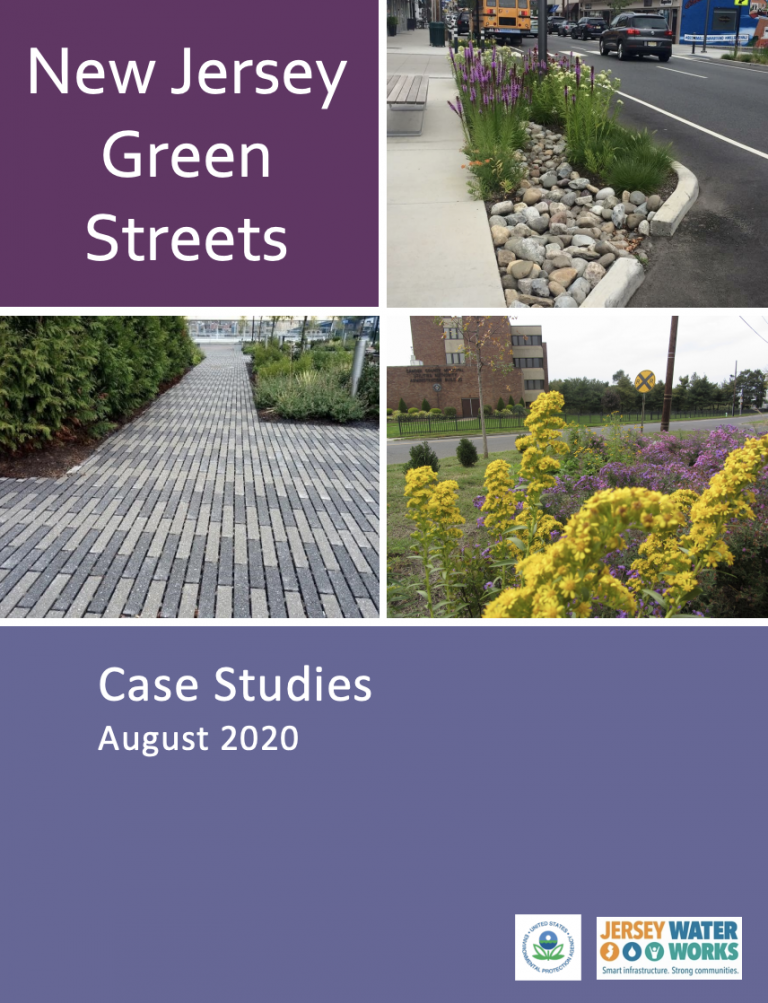
New Jersey Green Streets Case Studies
As of 2019, 151 municipalities in New Jersey have adopted complete streets policies, but most have not incorporated green streets language or requirements into their policies. Municipalities can enhance their roadways by incorporating green streets practices into their complete streets designs. Green streets can help meet regulatory requirements for stormwater management, provide important environmental and public health benefits, and provide ...LEARN MORE#Green Infrastructure/Stormwater ManagementPRODUCT OF
-
 07/30/20
Green Infrastructure Recommendations for Consideration within the Green Acres Reauthorization
In July 2020, the Jersey Water Works Green Infrastructure Committee sent recommendations for consideration by the Department of Environmental Protection to the re-authorization of the Green Acres rules. The Green Infrastructure subcommittee focused its efforts to understand the limitations of the current rule towards green infrastructure, and propose revisions that integrate green infrastructure into the Green Acres grant application process ...LEARN MORE#Green Infrastructure/Stormwater ManagementPRODUCT OF
-
 06/09/20
Assessing Public Input and Consideration of Green Infrastructure in NJ CSO Reports
This paper, "Assessing Public Input and Consideration of Green Infrastructure in NJ CSO Reports", assesses how well the Combined Sewer Overflow (CSO) Development and Evaluation of Alternatives Reports meet the Jersey Water Works (JWW) goals for “Smart CSO Plans.” The Development and Evaluation of Alternative Reports (DEARs) were submitted to the New Jersey Department of Environmental Protection (NJDEP) in July 2019, with a deadline for the final ...LEARN MORE#Community Engagement and Partnerships,#Green Infrastructure/Stormwater Management,#Smart CSO Control PlansPRODUCT OF
-
 01/10/18
Mainstreaming Green Streets in New Jersey: Policy Recommendations for State Government
The Jersey Water Works Green Infrastructure Committee developed state-level policy recommendations to make green streets a mainstream practice in New Jersey based on research and discussion with key stakeholders including state agencies.LEARN MORE#Green Infrastructure/Stormwater ManagementPRODUCT OF
-
 12/14/16
Green Acres and Green Infrastructure
The Green Acres and Green Infrastructure report from Jersey Water Works' Green Infrastructure Committee recommends ways for New Jersey Green Acres Program to allow green stormwater infrastructure in existing parks. To prepare, the committee sought and received input from Jersey Water Works members.LEARN MORE#Green Infrastructure/Stormwater ManagementPRODUCT OF
Co-Chairs
*Member of the Jersey Water Works Steering Committee